
Ask Tough Questions.
Looking forward to the year ahead.

I’m not a resolution person.
I don’t make New Year’s resolutions. I never have. I think they’re cliché. I think they’re often bogus. And honestly, they tend to set us up for disappointment—if not by February, then certainly by the end of the year.
What I do believe in are intentions. Goals. Objectives. I’m a scientist, after all. I think in hypotheses and systems, not wishful thinking. That’s probably why resolutions have never worked for me. Intentions leave room for growth. They assume learning. They require adjustment.
So instead of a resolution, I’m setting a theme for the year: Ask Tough Questions.
A new year always invites declarations—priorities, strategies, action plans. But before we rush toward answers, perhaps the most important work is to pause and ask better questions.
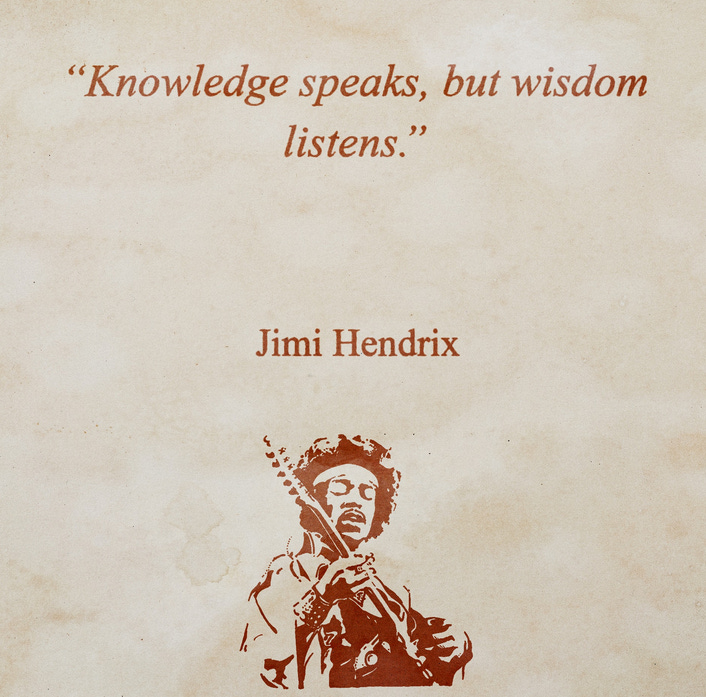
As attributed to Jimi Hendrix:
“Knowledge speaks, but wisdom listens.”
This year, I’m holding tightly to that distinction.
Knowledge Speaks. Wisdom Listens.
In higher education, we are very good at knowledge.
We speak fluently in dashboards, benchmarks, predictive models, strategic plans, and five-year visions. We talk—often confidently—about what students need, what’s working, and what isn’t. We generate reports, hold meetings, and declare initiatives.
But wisdom? Wisdom requires something much harder and far more vulnerable—especially in academia.
Wisdom listens. Especially when what we hear unsettles us.
Listening requires us to slow down our certainty. To resist defensiveness. To sit with critique without immediately explaining it away. And to take seriously the possibility that our systems, our traditions, and even our identities as professionals may need to be adapted.
Feedback, Critique, and Intersectionality
I believe in feedback. I work intentionally to provide it as a standard operating practice. I also ask for it—and listen.
This year, I received a great deal of feedback about Raise the Floor. Much of it was affirming. Many of you shared that the writing resonates, that it names realities you see and feel every day. I’m deeply grateful for that.
Some of the feedback, though, was critical. I am even more grateful for this.
I was told that I sound like I’m complaining. That I sound whiny. That it’s off-putting.
Fair.
I was also told that I’ve strayed from the agenda—that I’ve become overly critical, that perhaps I should dial it back.
Also fair—at least in the sense that I am being critical. But that part is intentional.
I am critical of a professorial culture that places students anywhere other than first. Second is not enough. Third is unacceptable. I am critical of administrations that lack transparency—because transparency is not optional; it is foundational. I am critical of leaders who weaponize emotion. I am critical of how “academic freedom” and shared governance are sometimes used to resist change, as if innovation hasn’t always been the engine of higher education’s greatest contributions.
But let me return to the agenda.
To understand how and why I write the way I do, it helps to understand the lens I bring to this work—my intersectionality.
I’ve spent 17 years in the university classroom teaching statistics and research methods, poverty studies, sociology of the family, and senior capstone courses. I served nearly four years as the director of a faculty development and innovation program. I’ve published on pedagogy, policy, p-values, and poverty, and presented at multiple international conferences. I’m also a social worker (MSW, 2003) and a sociologist (BA, 2001; PhD, 2010).
I’ve spent much of my life as an ally and advocate for marginalized populations. My research directly contributed to the establishment of a food pantry on my campus, and my dissertation was grounded in Marxist political economy.
I also spent five years professionally as a program evaluation and policy analysis consultant for federally funded IDEA and TANF programs across all 83 Michigan counties. I supported state- and county-level efforts to improve services for infants and toddlers with disabilities and for families involved in child abuse and neglect prevention systems. The coolest thing I did during those five years was present findings to a state senate budget subcommittee. The second coolest was presenting to the state board of education.
I’m someone whose voice doesn’t always fit comfortably within traditional higher education spaces—despite being, as I tell my introductory sociology students, an over-educated, cisgender, able-bodied, upper-middle-class white dude.
But, I have done some things.
All of this aside, I am critical of higher education because I deeply love its capacity to change lives—every single day.
I also understand that, despite the above, I am now often seen only as an administrator. That feedback was among the hardest to receive this year—and also one of the most impactful. It pushed my growth.
So yes—add administrator to this intersectionality.
This is the lens, the framework, and the experience I bring to my work. And if you can see past what might feel like grandstanding or New Year’s self-validation, I would ask you to focus on one word above all others: love.
Love does not require silence. And commitment does not mean complacency.
Ask Tough Questions
I started Raising the Floor as an opportunity to write and explore ideas and experiences, and to develop my own voice in this landscape. It has never been about incremental improvement at the margins—though I know higher education often moves like a glacier. It has always been about interrogating the material conditions that make success fragile for some students and seamless for others.

The floor—the metaphor—is the base. Raising the bar without strengthening the base serves students who arrive two or three generations deep into college-going, from well-resourced secondary institutions, with different opportunities leading to a higher starting point. Meanwhile, at-promise students, nontraditional learners, and neurodivergent students are too often left navigating siloed structures and fragmented systems.
So this year, I am intentionally centering tough questions—both here and in my daily work—to raise the floor for all students.
For me, that means asking tough questions of myself and others—questions that don’t fit neatly into existing structures or confirm our assumptions.
Questions like:
Who is consistently thriving here—and who is merely surviving?
What are students navigating that our policies quietly ignore?
Where have we confused access with equity?
Which practices persist because they are familiar, not because they are just? Or ethical?
These are not comfortable questions. They challenge material conditions many of us benefit from. They force us to examine not just programs, but power, culture, and accountability.
And the answers must be honest, critical, vulnerable, and innovative.
“This is how it’s always been done” is not an answer.
“This is how I learned it” is not an answer.
“This would set a dangerous precedent” is not an answer.
“Because I would have to update my syllabus” is not an answer.
Listening as an Act of Courage
Listening is often framed as passive. It is anything but.
To truly listen—to students, to staff, to faculty, and to communities at the margins—is to risk being changed by what we hear. It requires resisting the urge to defend, explain, or fix too quickly. It asks us to sit with complexity, contradiction, and critique.
It also requires honesty.
I talk with my statistics students about a similar way of thinking, the statistical imagination. That is, the openness to allow statistics (as a discipline) to inform our perspectives and challenge our assumptions (see social worker reference above).
Higher education has long been a seedbed of innovation—the beacon of liberal education and a gateway to civic participation. So why are we so siloed, insular, and fearful of progress within our own institutions when proven practices and troves of hypothesis tests have confirmed business as usual is not sustainable? Why do we resist opportunities to grow and evolve as both individuals and organizations? Why are we shocked when social and technological change outpaces our willingness to adapt?
For instance, we should not have been surprised by the release of ChatGPT. We should not have panicked. We should have listened to the voices that anticipated it. We should have been prepared. That moment exposed something we often avoid naming: higher education is frequently reactive when it should be visionary.
And if that freaked you out, just wait until you learn about the capabilities of smart glasses.
My Intention: Ask Tough Questions
Asking tough questions is not an endpoint. It is a commitment.
A commitment to learning without defensiveness.
To evolving without nostalgia.
To challenging inequitable norms and siloed approaches.
To innovating beyond performative change.
I am compelled to align my values, my rhetoric, and my realities on the ground. I call this authenticity—not the curated kind, but the kind that admits missteps, names tension, and chooses courage over comfort.
So this year, I’m asking myself questions like:
What can I do differently, better, or more innovatively to engage my team?
How can I help students engage ideas from perspectives beyond their own?
How do I apply a critical lens to AI in my role while raising the floor for staff and students to do the same?
How can I more effectively engage stakeholders in hard—but necessary—conversations?
How can I better educate institutional leadership about innovative pathways and persistent barriers to student success?
As we step into this new year, my intention is simple—but demanding:
Ask tougher questions.
Listen more deeply.
Learn without defensiveness.
Evolve with purpose.
And push—always—with integrity.
Raising the floor is not about having all the answers. It’s about being brave enough to ask the questions that make transformation possible—and wise enough to truly hear what comes back. Watch this space.
That’s my agenda.